Trying to make sense of Seattle’s many waterfront options? You are not alone. The shoreline here spans lakes, canals, and Puget Sound, and each type comes with different access, views, permits, and upkeep. In this guide, you will learn the key terms, what daily life feels like in each setting, how rules and permits work, and what to verify before you buy. Let’s dive in.
Key shoreline terms to know
Ordinary High Water Mark (OHWM)
The OHWM is a legal line used to decide where shoreline rules start. It helps determine whether a structure is over water or on land. You will want a survey and title review to confirm the OHWM location and whether tidelands are included in ownership.
No-bank, low-bank, and high-bank (bluff)
- No-bank means the land slopes gently into the water, so you have immediate access. Privacy and wake exposure can vary.
- Low-bank has a modest drop to the shore and often easier access without long stairs or lifts.
- High-bank or bluff is elevated and usually offers the widest views and more separation. It can require stairs, a tram, or engineered access and will involve careful review of slope stability.
Tide-influenced vs. non-tidal
- Tide-influenced shorelines include Puget Sound and connected inlets. You will experience changing tides, currents, and an intertidal zone.
- Non-tidal lakes like Lake Washington and Lake Union have managed water levels. Levels change seasonally and through the lock system rather than with daily tides.
Over-water structures and moorage
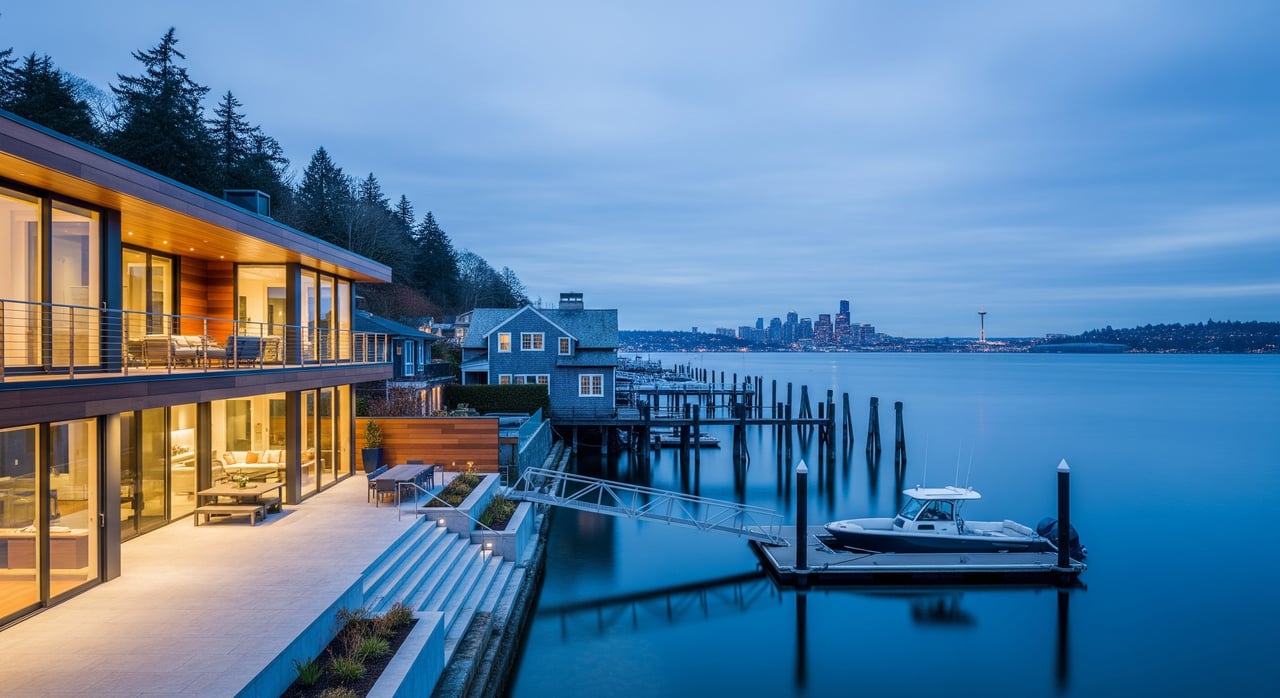
- Private fixed pier or pile-supported dock handles larger vessels but requires permits and may need mitigation.
- Floating docks rise and fall with water levels and can reduce piling impacts but have floats to maintain over time.
- Boatlifts store vessels out of the water, reducing fouling but adding structural needs.
- Community marinas and condo slips offer convenience and shared maintenance. Slip rights, transfer rules, and fees vary.
- Moorage rights can be recorded or absent. Do not assume rights exist just because neighbors have docks.
Shoreline armoring vs. soft shore
- Bulkheads and seawalls protect against erosion but are heavily regulated because they change habitat and sediment movement.
- Soft-shore methods use grading, native plants, and logs to stabilize while supporting habitat. These are often preferred under current rules.
Lifestyle and access differences
- No-bank and low-bank give you the easiest water access for kayaking, paddle boarding, and swimming. If you want to launch often, these settings fit well.
- Bluffs favor privacy and sweeping views, which are ideal if you value quiet and vistas over daily water access. They are less convenient for frequent boating.
- Your moorage type shapes your boating life. A private dock gives control and privacy. A community marina lowers hands-on maintenance but adds shared rules and fees.
Maintenance and cost realities
- Docks and floats need routine inspections, fastener checks, and float replacements over time. Salt water can increase corrosion and marine borer issues compared to the lakes.
- Bulkheads and seawalls are costly to build or repair, and permits can be complex. Failure risks are significant.
- Bluff properties can require geotechnical work and engineered solutions for stability and safe access.
- Vegetation and shoreline restoration may be required or recommended, especially near sensitive habitats.
- Insurance needs can vary with elevation, flood zones, and over-water structures. Ask about flood coverage, elevation certificates, and any history of storm impacts.
Permits and rules in Seattle and King County
Waterfront changes are governed by several layers of regulation.
- Washington State’s Shoreline Management Act sets the framework that local programs follow.
- Within Seattle, the Shoreline Master Program and the Department of Construction and Inspections oversee docks, lifts, and armoring.
- King County has its own shoreline rules and Critical Areas Ordinances for unincorporated areas.
- State agencies can be involved, including the Department of Fish and Wildlife for Hydraulic Project Approval when you work near or below the OHWM, and the Department of Natural Resources for aquatic lands. The Department of Ecology provides shoreline guidance. The U.S. Army Corps of Engineers may oversee certain work in navigable waters.
- FEMA flood maps affect insurability and can drive lender requirements.
Typical needs for shoreline work can include a shoreline substantial development permit, conditional use or variance approvals, building and electrical permits, a Hydraulic Project Approval, geotechnical reports for bluffs, and habitat mitigation where required.
Lake-by-lake: where each type shines
Lake Washington
You get a big-lake lifestyle with room for larger boats, waterskiing, and long vistas. Shorelines range from low-bank yards with docks to high-bank bluffs with dramatic views. Many homes feature established private moorage. Regulations still apply, but marine habitat standards are generally different than on Puget Sound.
Lake Union
This is urban waterfront living with floating homes, houseboat communities, and active maritime uses. You are close to downtown and major employers, with seaplanes and yacht clubs nearby. Expect dense waterfront activity and specific rules for over-water housing, moorage agreements, and utilities.
Puget Sound–facing
Elliott Bay, Alki and West Seattle, and Magnolia offer saltwater views and a stronger connection to tides and marine conditions. You will feel winds, waves, and tidal ranges more than on the lakes. Permitting typically places more emphasis on eelgrass, forage fish beaches, and marine habitat.
Neighborhood snapshots
- Lake Washington corridors: well-established waterfront with a mix of low-bank and bluff settings. Notable areas include Laurelhurst, Leschi, Madison Park, and eastside enclaves such as Medina and Yarrow Point.
- Lake Union corridor: Eastlake, Westlake, and South Lake Union feature floating homes, moorage communities, and walkable urban amenities.
- Puget Sound and Elliott Bay: Magnolia, Alki and West Seattle, and shoreline pockets near downtown offer beach access, bluffs, and pocket coves with strong view corridors.
Use these snapshots to guide lifestyle fit rather than assume any one area has the same shoreline type throughout.
Buyer’s verification checklist
- Title and moorage rights
- Confirm whether tidelands are included in ownership and whether any moorage rights are recorded.
- Review HOA or marina agreements for slip assignment, fees, and transfer rules.
- Survey and boundaries
- Order a current survey that identifies the OHWM or mean higher high water, as applicable.
- Verify setbacks from the OHWM, bluff edges, and any critical areas.
- Permits and history
- Request permit records for existing docks, lifts, bulkheads, and repairs.
- Check for mitigation conditions or ongoing obligations.
- Physical condition
- Inspect piles, floats, fasteners, and any dock electrical. Review reports if available.
- Assess bulkhead condition for undermining or failure signs.
- For bluffs, request geotechnical reports and landslide history.
- Confirm utilities and sewage for floating homes and dock power/water connections.
- Environmental constraints and timing
- Ask about eelgrass, forage fish beaches, and fish habitat. These can limit project timing and methods.
- Understand seasonal work windows for in-water activity.
- Flood and hazards
- Verify FEMA flood zones and insurance needs. Review any storm damage history.
- On Puget Sound, evaluate wind and wave exposure relative to orientation and fetch.
- Access and navigation
- Confirm depth at low water for your vessel, proximity to channels, and any obstructions.
- Note public trails, walkways, or parks nearby that may influence privacy.
- Financial outlook
- Budget for marina fees, dock and bulkhead reserves, and potential permit or mitigation costs.
- Understand tax implications for over-water structures.
Which waterfront is right for you?
- Choose Lake Washington if you want a big-lake boating lifestyle with room for larger vessels and a mix of private docks and bluffs.
- Choose Lake Union if you value an urban setting with floating homes, active marinas, and walkable daily living.
- Choose Puget Sound if you want saltwater views, open-water boating, and are comfortable planning around tides and marine conditions.
If you are weighing privacy and views against direct water access, a bluff may fit best. If daily kayaking, swim ladders, and quick boarding are priorities, look to low-bank or no-bank. Match the shoreline to the way you plan to use it, then confirm rights, permits, and structural details before you write an offer.
For confidential, principal-led guidance on Seattle and Eastside waterfront, connect with Patricia Wallace for a private consultation.
FAQs
What does “low-bank” waterfront mean in Seattle?
- Low-bank indicates a modest drop to the water that usually allows easier access without long stairs, offering a balance of usability and view.
How do tides affect Puget Sound homes compared to lakefront?
- Puget Sound properties experience daily tidal swings, currents, and an intertidal zone, while Lake Washington and Lake Union have managed levels with seasonal variation.
Do all Seattle waterfront homes include rights to build a dock?
- No. Dock eligibility depends on recorded rights, tideland ownership, local shoreline rules, and habitat constraints. Always verify with title, survey, and permitting staff.
What permits are common for dock or bulkhead work in Seattle?
- You may need shoreline permits from the city, a Hydraulic Project Approval from the state, building permits, and possibly federal approvals, plus habitat mitigation.
What should I check before buying a bluff property with views?
- Review geotechnical reports, past landslide history, and access plans. Confirm setbacks from bluff edges and any critical-area rules.
How do community marina slips compare to private docks for buyers?
- Marinas offer convenience and shared maintenance with rules and fees, while private docks provide privacy and control but require direct upkeep and permitting for changes.